E N T J
So, you're an ENTJ.
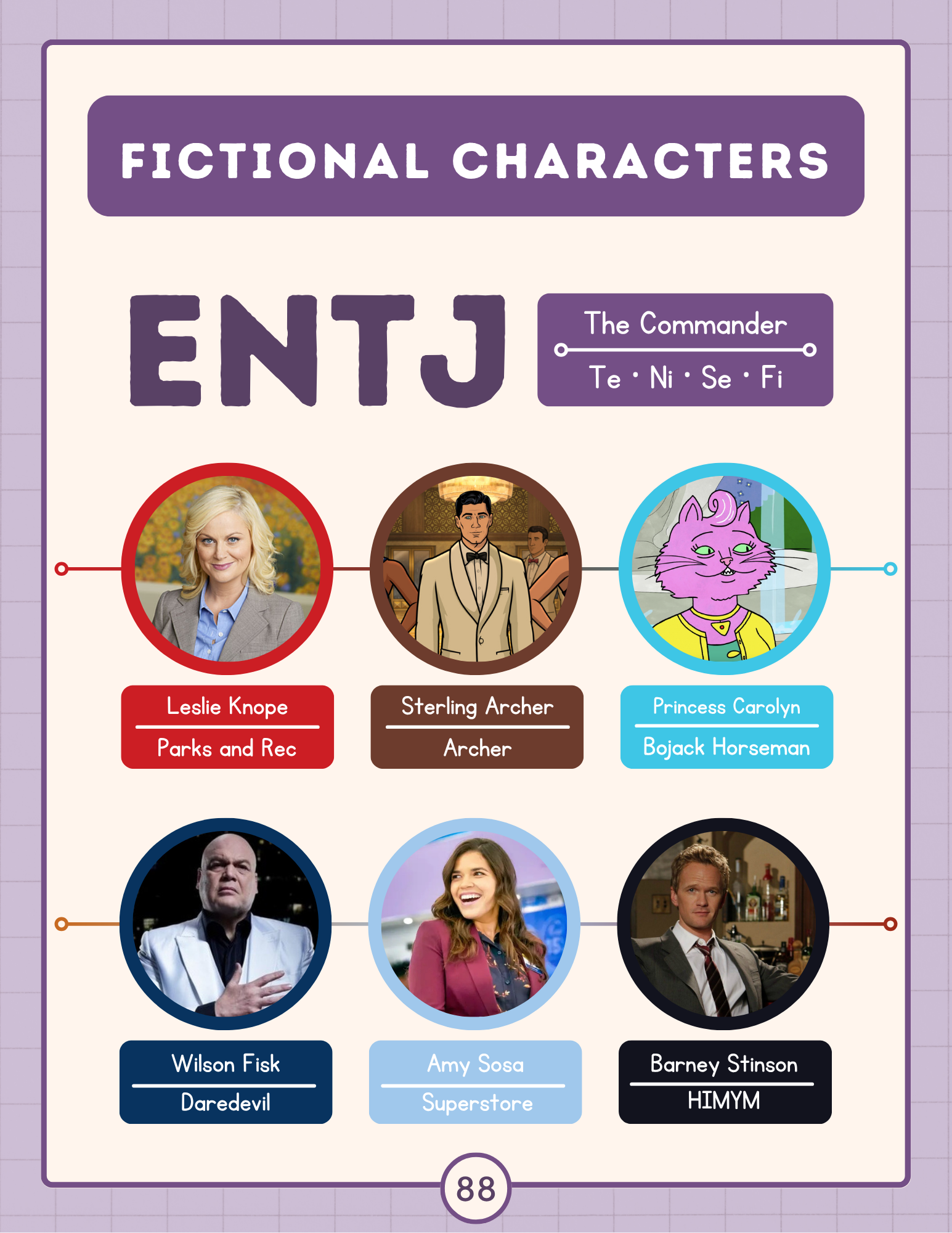
The Commander
You walk into a room and see what needs to happen. You organize people, systems, and plans with a confidence that is partly strategic and partly instinctive. You are not interested in how things have always been done. You are interested in how they should be done.
Te · Ni · Se · Fi

ENTJ at a glance
A quick portrait before you go deeper. None of this is a box; it is a starting point for understanding how your mind tends to work.
Strengths
- Decisive, natural leadership
- Strategic long-range thinking
- Relentless execution
- Directness and clarity
Struggles
- Steamrolling people's feelings
- Impatience with slow processes
- Difficulty being vulnerable
- Overworking and burnout
At your best
- Building something that lasts
- Inspiring people to perform
- Cutting through politics to results
- Loyal and protective of your people
Under stress
- Becoming dictatorial
- Emotional outbursts that shock everyone
- Withdrawing into self-doubt
- Feeling fundamentally unlovable
Your cognitive functions
The eight processes behind the four letters
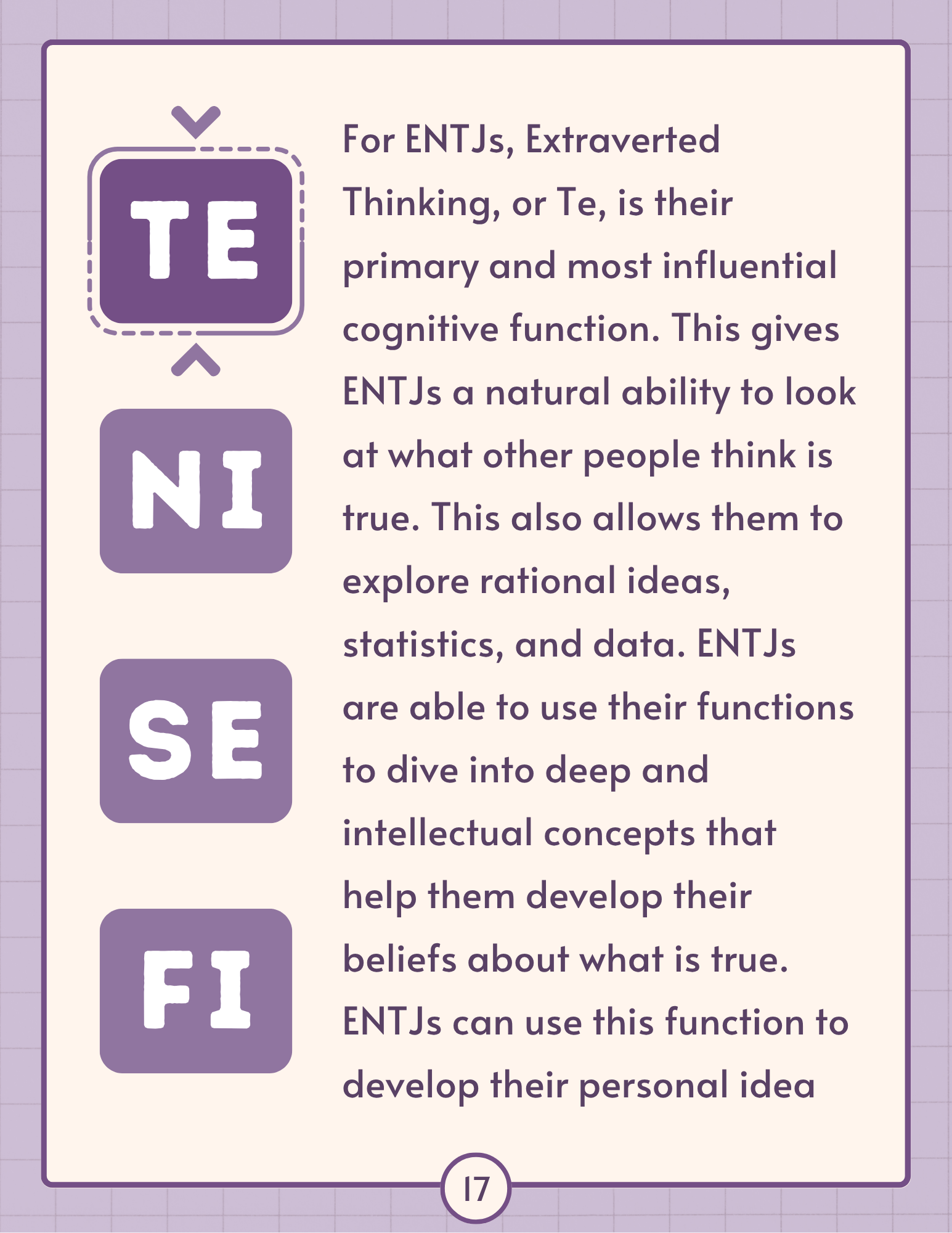
Your type is not really four letters. It is an ordered stack of eight mental processes, each one more or less conscious than the next. The first four you use naturally. The last four are your shadow, and they mostly show up when you are stressed or pushed. Tap any function to see how it works in you.
Conscious stack
Shadow stack
Extraverted Thinking
Your lead process. You organize the external world: people, systems, resources, timelines. You think out loud, decide fast, and measure everything by whether it works. This is your engine. It makes you formidable at execution, blunt in communication, and genuinely bewildered when other people seem to value process over results. It is also why you can bulldoze through people without noticing you have done it.
Your directness is a gift, but it lands differently than you think. Before you deliver the verdict, spend ten seconds on the frame: acknowledge what is working before you fix what is not. The result is the same; the damage is not.
Position 1 of 8 · most conscious
Introverted Intuition
Your strategic depth. Behind the blunt executor sits a pattern-reader that sees where things are heading years from now. This is what separates you from someone who is just bossy: you are not just organizing the present, you are building toward a future you can already see. It gives you vision, foresight, and an almost eerie ability to predict how a situation will play out.
Trust your gut more than you do. You default to Te's hard data, but your Ni is often right before the numbers confirm it. The best ENTJ decisions combine both: the vision to see where things are going and the data to prove it to everyone else.
Position 2 of 8 · supporting
Extraverted Sensing
Your playful, commanding presence. You are more physically present and in-the-moment than most NT types. You enjoy good food, sharp clothes, impressive spaces. It gives you charisma and a physical authority that backs up your decisiveness. When it is working well, it keeps you grounded and lets you read the room at a sensory level, not just an intellectual one.
Lean into this one for recharging. You think of yourself as a strategist, but your Se is what keeps you human. Good meals, physical challenges, travel, luxury without guilt: these are not distractions from your work, they are fuel for it.
Position 3 of 8 · relaxed and playful
Introverted Feeling
Your growth edge, and the one that catches you off guard. You carry deep feelings, personal values, and a capacity for loyalty that can shock the people who know you as the decisive commander. But accessing these feelings, knowing what you actually want apart from what needs to be done, does not come naturally. Under stress, Fi erupts: sudden emotional outbursts, feelings of being fundamentally unlovable, or a conviction that nobody sees the real you.
You cannot efficiency-hack your way through your own feelings. When something hurts, sit with it instead of solving it. The people closest to you do not need your competence; they need to see that you are a person, not a machine. That vulnerability is not weakness. It is the thing that makes loyalty stick.
Position 4 of 8 · least conscious, most aspirational
Introverted Thinking
The doubting shadow of your thinking. Where your Te decides and acts, Ti under stress second-guesses: is this really logically sound? Am I missing something? It can send you into uncharacteristic analysis paralysis, picking apart your own decisions after the fact, looking for the flaw that will prove you were wrong all along. It turns your confidence against itself.
When you catch yourself endlessly re-analyzing a decision you already made, name it as your nemesis, not due diligence. Your Te made the call with the information it had. Revisit if new data arrives; do not revisit because anxiety is dressed up as logic.
Position 5 of 8 · shadow
Extraverted Intuition
A harsh judge of possibilities. Where your Ni quietly focuses on one strategic direction, Ne under stress floods you with every alternative you did not choose and every way your plan could fail from an angle you have not considered. It can make you dismissive of other people's ideas because you are already drowning in doubts about your own, even if you would never admit it.
If you are shooting down every idea in the room, ask yourself whether you are actually evaluating them or just defending your own plan from the anxiety of alternatives. Confidence is not the same as closing your ears. Let one idea in that you did not come up with.
Position 6 of 8 · shadow
Introverted Sensing
Your awkward relationship with the past and with routine. You push forward so hard that you forget what you have already learned, neglect your body, and dismiss precedent even when it is useful. Details that seem minor, promises you made in passing, physical warning signs, can slip right past you. When this function trips you up, it is usually because you have ignored something concrete and immediate in favour of something strategic and future.
Delegate the detail management, but do not dismiss it. Build one reliable system for tracking commitments and physical health. Your body and your promises are not obstacles to your vision; they are the foundation under it.
Position 7 of 8 · shadow
Extraverted Feeling
Your deepest blind spot. Under extreme stress, this can erupt as manipulative emotional behaviour that shocks everyone, including you: guilt-tripping, emotional coercion, or a sudden desperate need to be liked that is completely at odds with your usual commanding presence. Alternatively, it shows up as a total inability to read the emotional room, plowing through a social situation that everyone else can see is on fire.
If you find yourself trying to control people emotionally rather than strategically, stop. That is your demon function, and it does not work for you the way Te does. Step back, reconnect with your Fi: what do you actually feel? Deal with that honestly instead of projecting it outward.
Position 8 of 8 · least conscious
A few things that actually help
Not a life plan, just the handful of shifts that tend to make the biggest difference for ENTJs. Each one comes straight from your function stack.
Acknowledge before you optimize
Your Te sees what is broken instantly. But when you lead with the fix, people feel unseen. Name what is working first, then improve it. The same result, half the resistance.
Your feelings are data, not noise
Your Fi is weak but real. When something bothers you and you cannot name why, do not override it with logic. Sit with the feeling until it speaks. The ENTJs who burn out are the ones who treat their own emotions as inefficiency.
Let someone else lead sometimes
You default to command because nobody else seems to step up. But sometimes they do not step up because you never leave room. Step back deliberately. You will learn who you can trust, and they will learn they can trust themselves.
Rest is not laziness
Your Se knows how to enjoy the present, but your Te keeps telling you there is more to do. Scheduled downtime is not optional. The sharpest version of you is not the one running on fumes; it is the one who came back from a real break.
Go deeper
The ENTJ books
This page is the surface. The book goes all the way down, from the cognition behind your type to how it plays out in your relationships, your work, and your growth.
ENTJ Explained
Understand yourself
The complete breakdown of the ENTJ mind. Every function in your stack, how they work together, and why you command, build, and drive the way you do. If this page made something click, this is where the whole picture comes together.
- All eight functions in depth
- How your stack shapes you
- Strengths and blind spots
- What drives ENTJ behaviour
Not sure you are really an ENTJ?
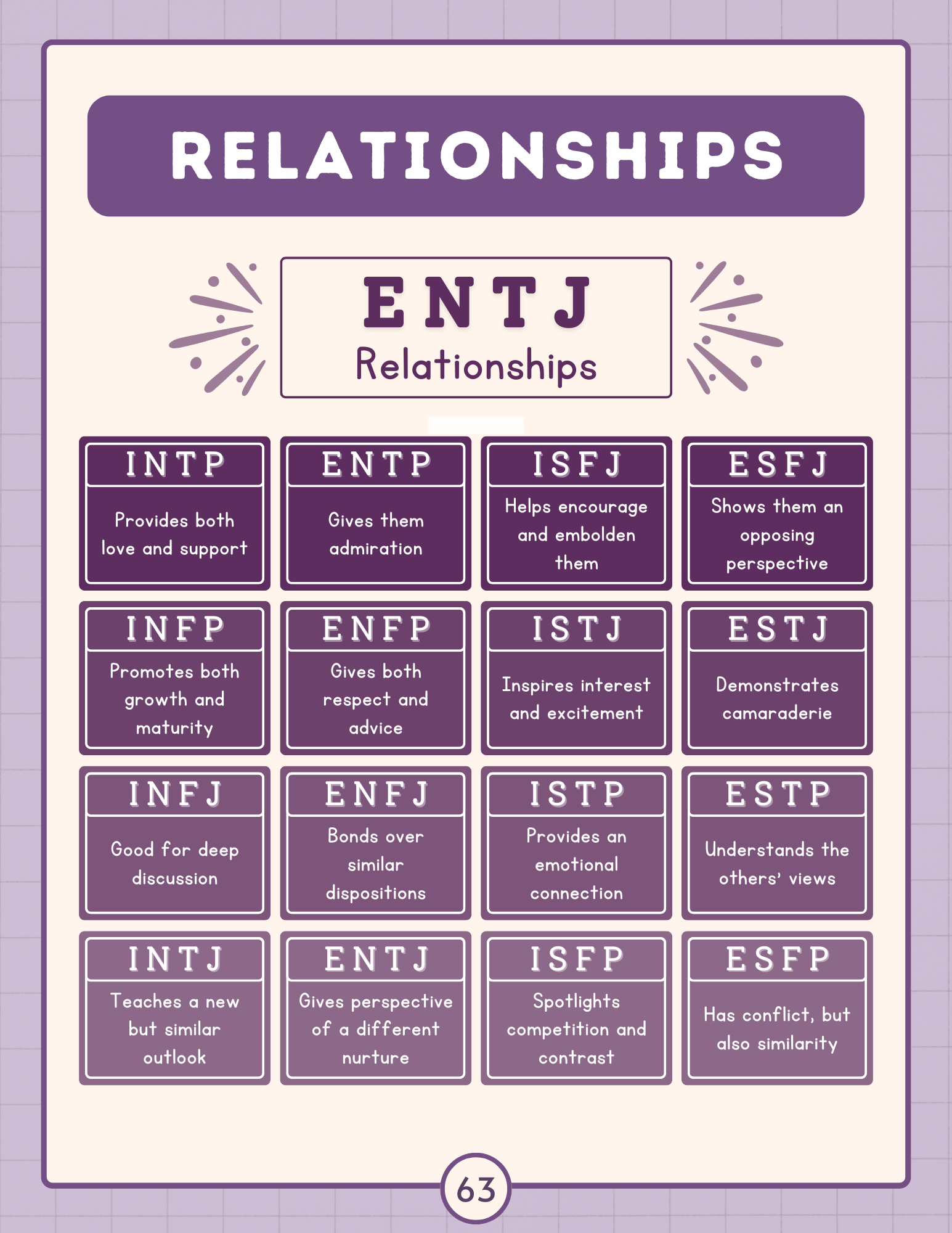
ENTJ gets confused with ESTJ and INTJ all the time. If you want to be certain, a typing session will settle it.