I N T P
So, you're an INTP.
The Architect
Your mind takes things apart. Not to break them, but to understand how they work at the deepest level. You build internal models of everything, you question what everyone else accepts, and you would rather be precisely right than conveniently agreeable.
Ti · Ne · Si · Fe

INTP at a glance
A quick portrait before you go deeper. None of this is a box; it is a starting point for understanding how your mind tends to work.
Strengths
- Razor-sharp analytical thinking
- Seeing through flawed logic
- Original, independent ideas
- Genuine intellectual honesty
Struggles
- Overthinking into paralysis
- Difficulty expressing feelings
- Procrastination and inertia
- Dismissing what cannot be reasoned
At your best
- Solving problems nobody else can frame
- Quietly funny and disarming
- Building elegant mental models
- Honest when everyone else hedges
Under stress
- Withdrawing completely
- Emotional outbursts that shock you
- Obsessing over being liked
- Rigid clinging to routine
Your cognitive functions
The eight processes behind the four letters
Your type is not really four letters. It is an ordered stack of eight mental processes, each one more or less conscious than the next. The first four you use naturally. The last four are your shadow, and they mostly show up when you are stressed or pushed. Tap any function to see how it works in you.
Conscious stack
Shadow stack
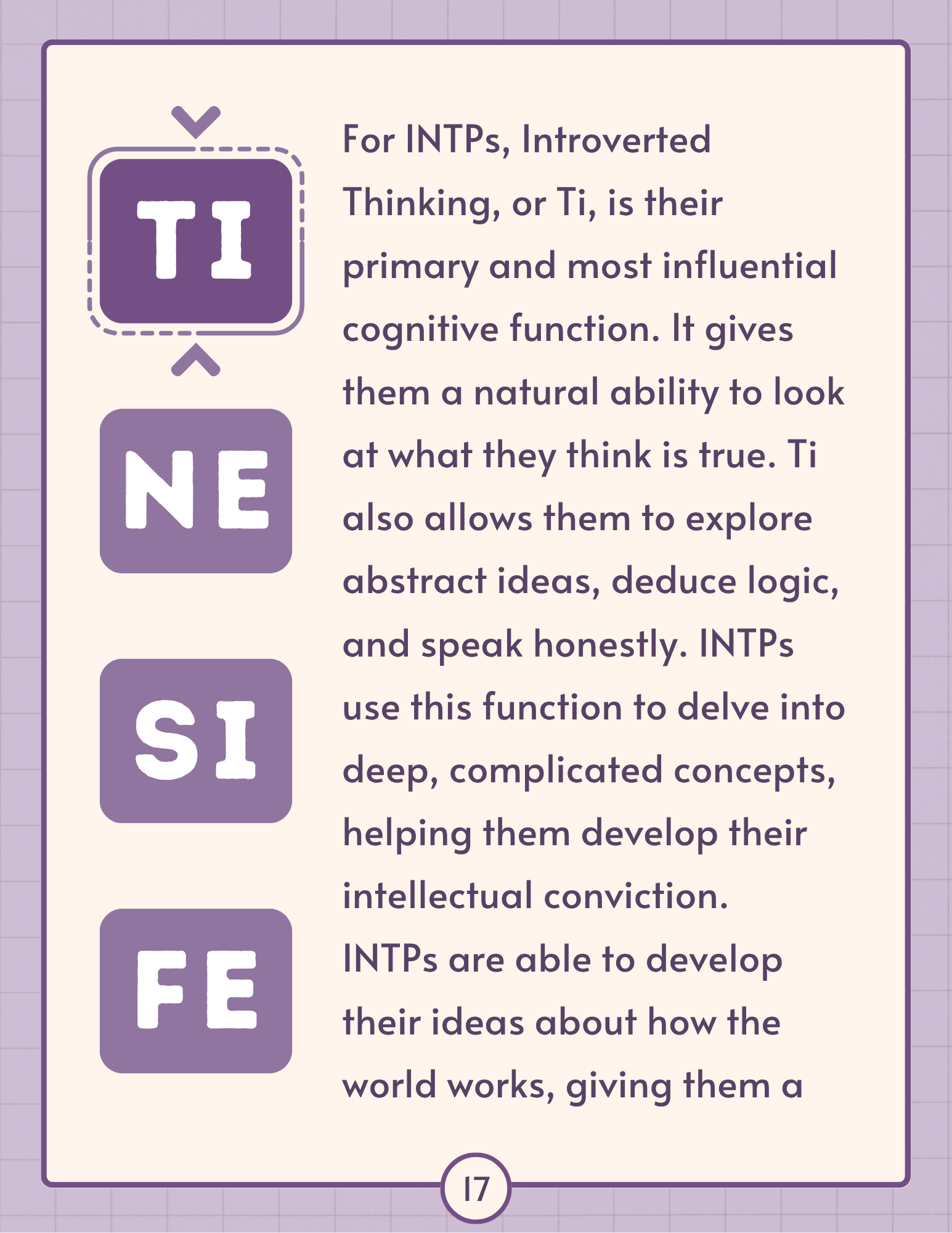
Introverted Thinking
Your lead process. You build internal frameworks for understanding how things work. Every idea gets taken apart, tested for internal consistency, and rebuilt from first principles. You do not accept anything because someone said so; you accept it because it holds up under your own analysis. This is the source of your precision, your independence of thought, and your tendency to correct people when they are technically wrong about something that does not matter.
Your analysis is usually right, but it can run forever. Set a point where the thinking becomes doing. You do not need to have the complete model before you act; you need a good enough model and the willingness to revise it with new data.
Position 1 of 8 · most conscious
Extraverted Intuition
Your idea generator. While your Ti analyses in depth, your Ne generates the raw material: connections, possibilities, angles nobody else has considered. It is why you can look at a problem from seventeen sides before breakfast and why conversations with you tend to go sideways in the best way. It gives your internal logic something to chew on and keeps you from getting stuck in a single line of reasoning.
Ne is your bridge to the outside world. Use it deliberately: brainstorm with other people, read widely across fields, expose yourself to ideas that have nothing to do with your current interest. Your best insights come from collisions between things that seemed unrelated.
Position 2 of 8 · supporting
Introverted Sensing
Your comfort zone. You have a stronger relationship with routine and familiarity than most people expect from you. The same meal, the same chair, the same playlist, the same corner of the house: these provide a kind of quiet stability that frees up your Ti to do its real work. When Si takes over, though, it can pull you into inertia and procrastination, where the familiar becomes a prison instead of a foundation.
Use your routines as a launchpad, not a hideout. If the same environment, the same food, and the same schedule are keeping your mind free, great. If they are keeping you from starting things, you have let comfort become avoidance. Change one thing, and your Ne will wake back up.
Position 3 of 8 · relaxed and playful
Extraverted Feeling
Your growth edge, and the one that scares you most. Social harmony, reading the room, expressing warmth, navigating group dynamics: none of this comes naturally. You can feel clumsy, fake, or painfully visible when you try. Under stress, Fe erupts in one of two ways: sudden emotional outbursts that shock everyone, including you, or a desperate, uncharacteristic need to be liked and accepted that feels nothing like your usual detached self.
You do not need to perform warmth. But you do need to let people in. Start small: tell one person what they mean to you, ask how someone is doing and actually listen, show up for the social thing even when you would rather stay home. Your Fe grows through use, not through thinking about it.
Position 4 of 8 · least conscious, most aspirational
Extraverted Thinking
The doubting mirror of your thinking. Where your Ti builds elegant internal models, Te under stress demands external proof: credentials, metrics, measurable output. It can make you suddenly anxious about productivity, about whether your ideas have any real-world value, or about whether you are falling behind people who are less smart but more organized. It turns your intellectual confidence into imposter syndrome.
When you catch yourself measuring your worth by output or comparing yourself to people who "ship" more, that is your nemesis, not the truth. Your value is in the quality of your thinking, not the volume of your results. But also: pick one idea and finish it. That quiets the Te doubt better than any reassurance.
Position 5 of 8 · shadow
Introverted Intuition
A harsh judge of meaning and direction. Where your Ne stays open to every possibility, Ni under stress narrows into one dark certainty: none of this is going anywhere, you are wasting your potential, there is no point to any of it. It can turn your intellectual curiosity into existential despair, convincing you that your explorations are just avoidance dressed up as thinking.
If you suddenly feel certain that everything is meaningless, that is your critic, not your intelligence. Go back to your Ne: explore something new, start a conversation with someone who thinks differently. The openness is where your energy lives. The nihilism is a dead end.
Position 6 of 8 · shadow
Extraverted Sensing
Your awkward relationship with the physical world. You can be remarkably oblivious to your surroundings: bumping into things, forgetting to eat, wearing the same shirt three days running, not noticing that the room has gone dark. The immediate, physical, sensory present is not where your mind lives, and when you are forced to deal with it abruptly, you can feel overwhelmed or strangely incompetent.
You will not become a sensory person, and that is fine. But basic physical anchors keep your mind working: eat at regular times, move your body once a day, notice one physical detail in your environment right now. Your Ti works better in a body that has been fed and moved.
Position 7 of 8 · shadow
Introverted Feeling
Your deepest blind spot. Under extreme stress, this can surface as a sudden, intense conviction about your own worthlessness that bypasses all logic. You know rationally that it does not make sense, but the feeling is so raw and absolute that your Ti cannot touch it. Alternatively, it can erupt as a rigid, uncharacteristic moral stance that seems to come out of nowhere and that you defend with an emotional intensity that surprises even you.
If you feel a wave of self-hatred or worthlessness that your logic cannot argue away, that is your demon, not the truth about you. Do not try to think your way out; it will not work from here. Call someone. Say "I am not okay." Let your Fe do what your Ti cannot.
Position 8 of 8 · least conscious
A few things that actually help
Not a life plan, just the handful of shifts that tend to make the biggest difference for INTPs. Each one comes straight from your function stack.
Ship something before it is perfect
Your Ti wants to keep refining the model. Your Ne keeps opening new angles. Together, they can run forever. Pick one idea, give it a deadline, and put it into the world while it still feels unfinished. You can revise it later. You cannot revise something that never left your head.
Tell people what they mean to you
Your Fe is weak, and you assume people know how you feel. They do not. Saying "I appreciate you" or "that conversation mattered to me" feels awkward for about five seconds and stays with the other person for years. Do it anyway.
Move your body, not just your mind
You live in your head, and your body is mostly a vehicle for carrying your brain to a chair. But physical movement clears the mental fog that your Si comfort zone creates. Walk, swim, lift, stretch. Your best ideas will arrive when your hands are not on a keyboard.
Being right is not the same as being understood
You can win an argument and lose the person. Your Ti values precision; most people value feeling heard. When you catch yourself correcting someone, ask first: does this actually matter, or am I just scratching an itch? The relationships you keep are worth more than the points you score.
Go deeper
The INTP books
This page is the surface. The book goes all the way down, from the cognition behind your type to how it plays out in your relationships, your work, and your growth.
INTP Explained
Understand yourself
The complete breakdown of the INTP mind. Every function in your stack, how they work together, and why you analyse, question, and withdraw the way you do. If this page made something click, this is where the whole picture comes together.
- All eight functions in depth
- How your stack shapes you
- Strengths and blind spots
- What drives INTP behaviour
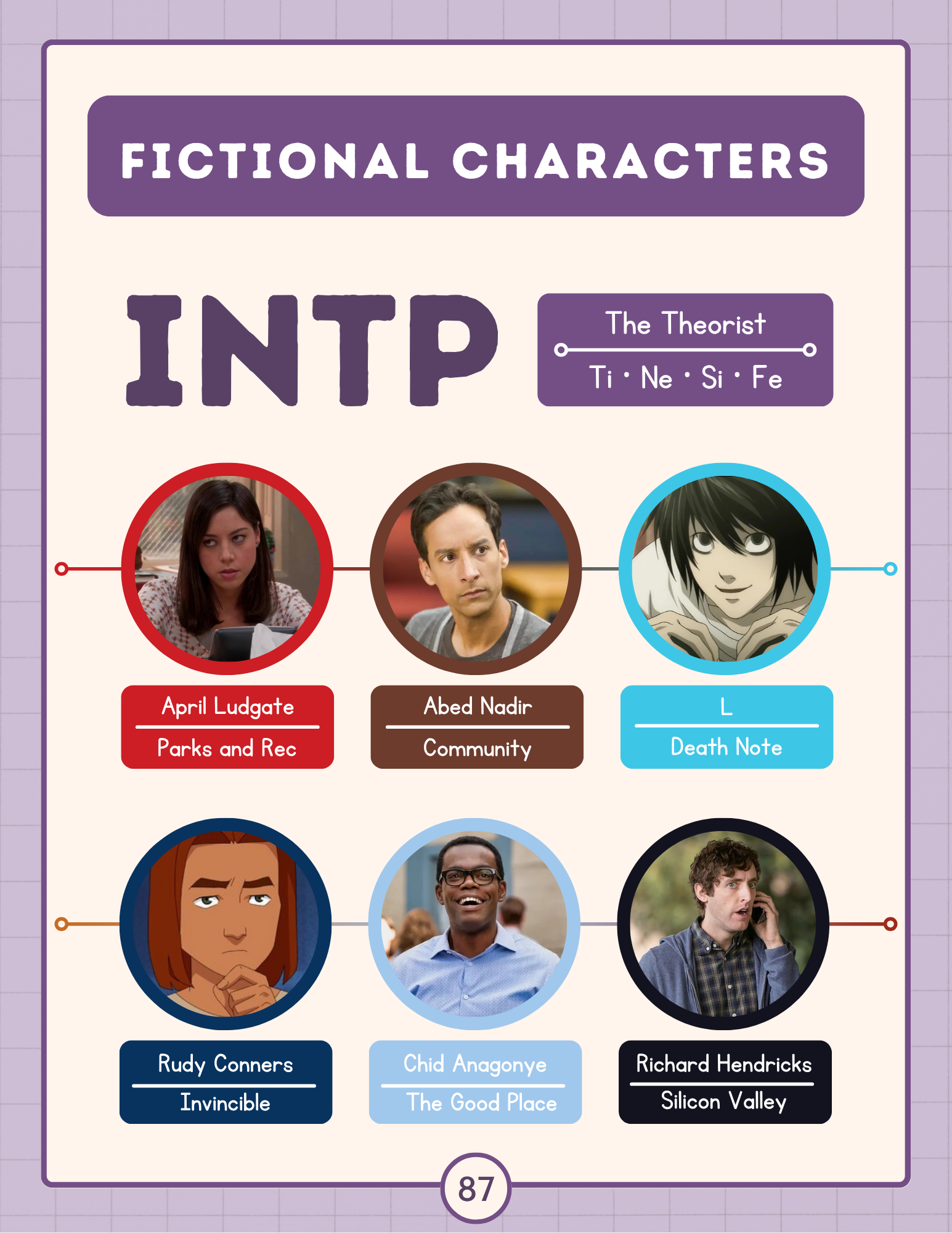
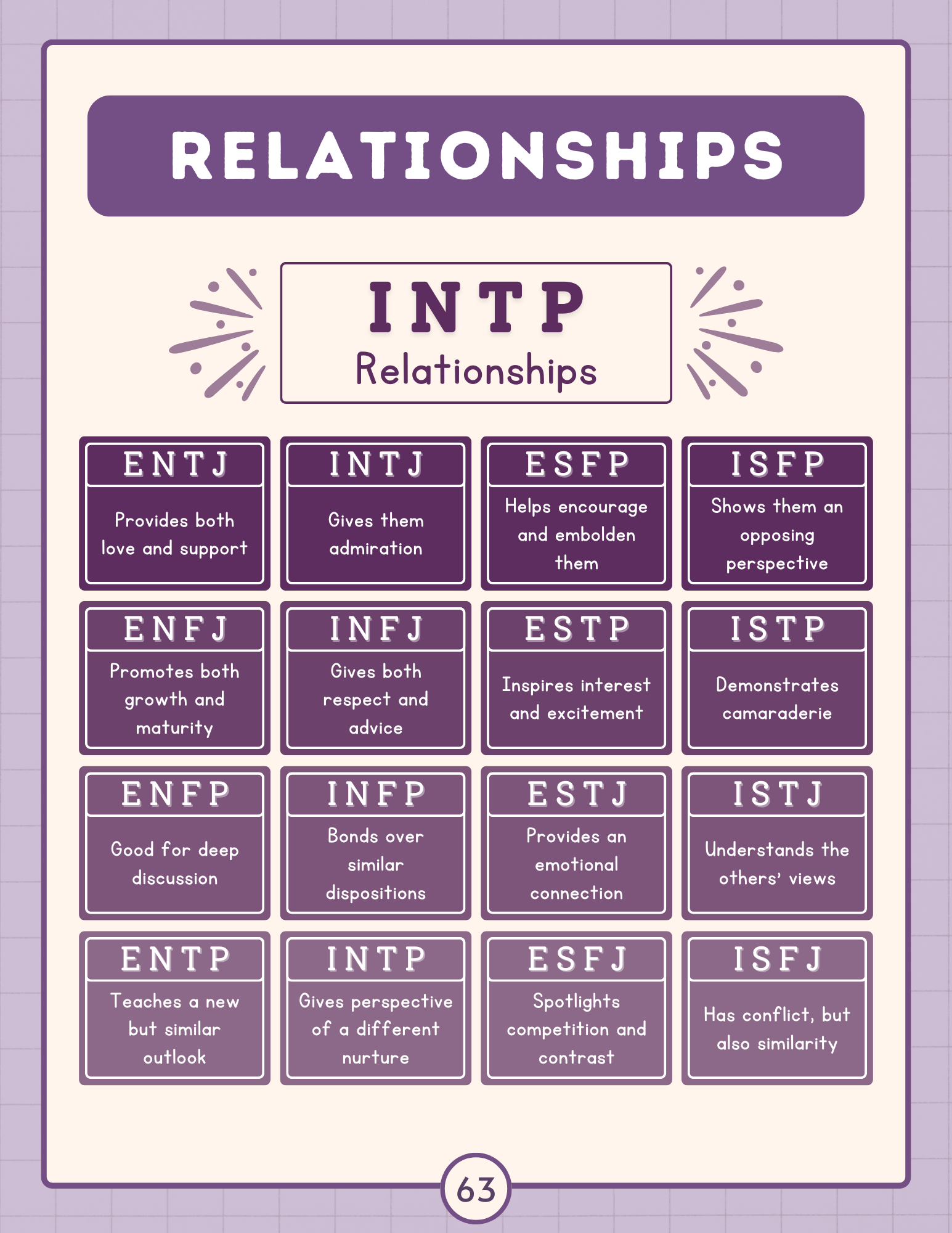
Not sure you are really an INTP?
INTP gets confused with INTJ and ISTP all the time. If you want to be certain, a typing session will settle it.