E N T P
So, you're an ENTP.
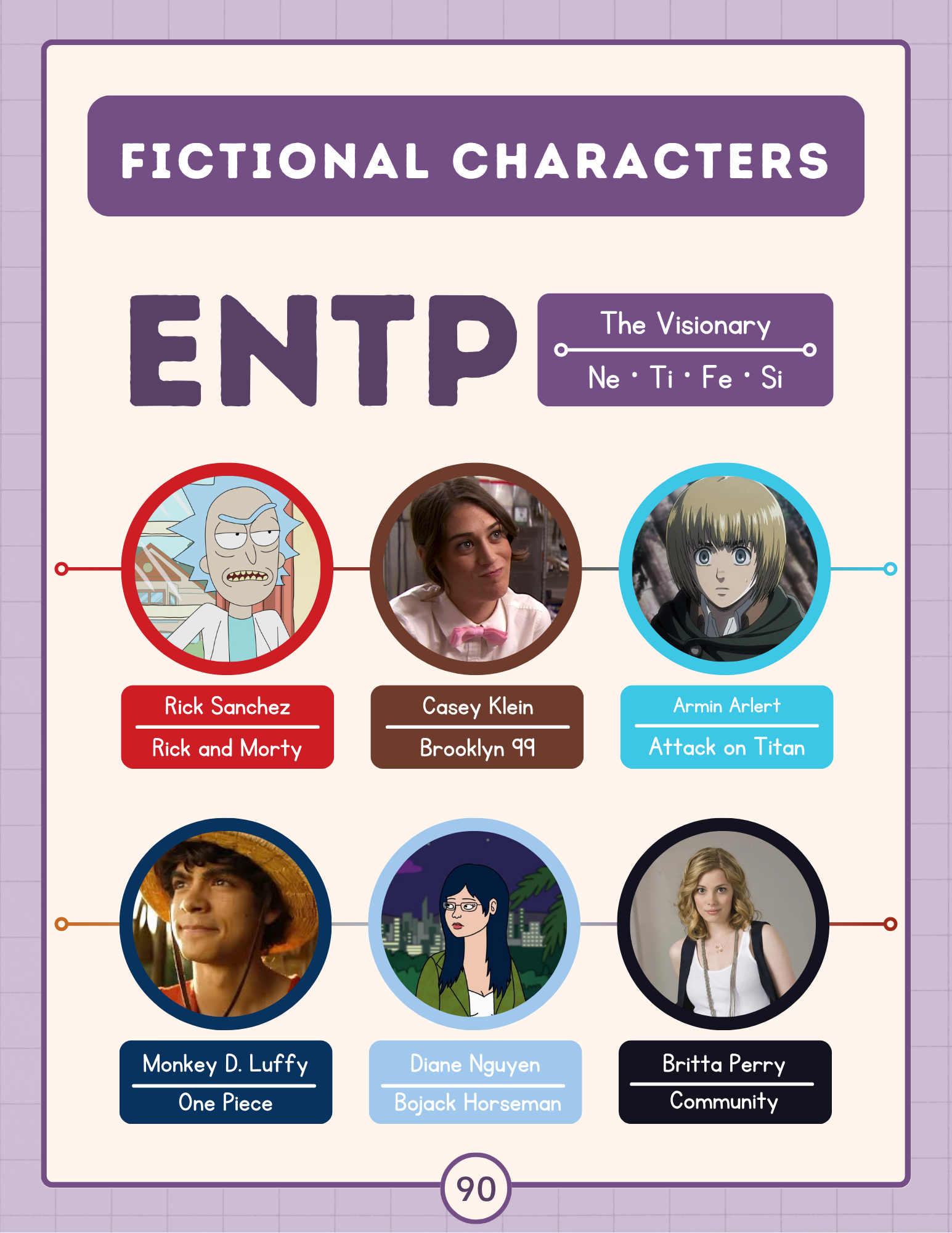
The Visionary
Your mind does not walk through doors; it kicks them open and checks what is on the other side. You argue for sport, invent for fun, and get bored the moment something becomes predictable. You are not trying to be difficult. You are trying to see what happens if.
Ne · Ti · Fe · Si

ENTP at a glance
A quick portrait before you go deeper. None of this is a box; it is a starting point for understanding how your mind tends to work.
Strengths
- Rapid-fire idea generation
- Seeing angles nobody else sees
- Quick, disarming wit
- Thriving under pressure
Struggles
- Starting everything, finishing little
- Arguing past the point of usefulness
- Avoiding emotional depth
- Restlessness and boredom
At your best
- Turning chaos into breakthrough
- Making people think differently
- Energizing any room you enter
- Building something genuinely new
Under stress
- Obsessing over small routines
- Becoming uncharacteristically rigid
- Withdrawing into cynicism
- Physical symptoms and health anxiety
Your cognitive functions
The eight processes behind the four letters
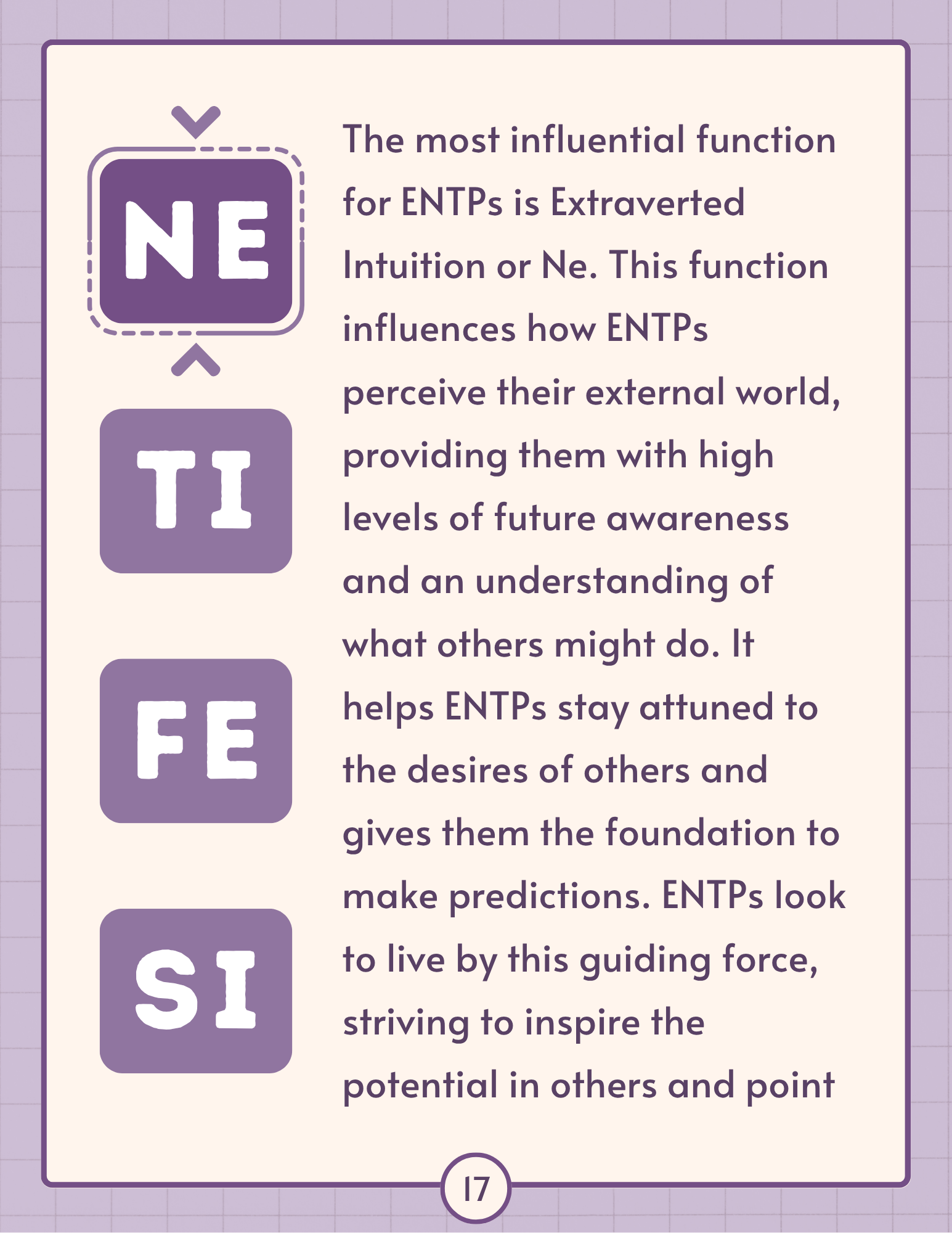
Your type is not really four letters. It is an ordered stack of eight mental processes, each one more or less conscious than the next. The first four you use naturally. The last four are your shadow, and they mostly show up when you are stressed or pushed. Tap any function to see how it works in you.
Conscious stack
Shadow stack
Extraverted Intuition
Your lead process. Your mind is a pattern-breaking machine. It takes the accepted way of seeing something and flips it, connects it to something unrelated, and generates a new angle before anyone has finished their sentence. This is your spark: the rapid-fire ideas, the devil's advocacy, the ability to see a system and instantly spot the loophole. It is also why you leave a trail of started-but-unfinished projects wherever you go.
Your Ne needs something to push against, or it just spins. Give it a constraint: a deadline, a limited scope, a real problem with stakes. You are at your most creative when you cannot do everything, not when you can.
Position 1 of 8 · most conscious
Introverted Thinking
Your analytical backbone. Behind the rapid-fire ideas sits a rigorous internal logic engine that tests each one for structural integrity. This is what separates you from someone who is just random: your ideas are wild but they hold up, because your Ti quietly checks them before you say them out loud (most of the time). It also powers your love of debate, because arguing is really just stress-testing ideas in real time.
Your Ti makes you sharp, but it can also make you dismissive. When you dismantle someone's argument, remember that you are also dismantling their confidence. Be right and be kind. You can do both; you just have to choose to.
Position 2 of 8 · supporting
Extraverted Feeling
Your social spark. You are more charming and socially adept than people expect from a "thinking" type. You can read a room, work a crowd, and make people laugh with surprising ease. This is Fe in its playful, childlike form: it wants to entertain and connect, and it gives you a warmth that catches people off guard. The catch is that it is not deep. When real emotional labour is required, you tend to deflect with humour or vanish.
Your charm is real, but it can become a shield. When someone comes to you with something serious, resist the urge to lighten the mood. Sometimes the most connecting thing you can do is just sit in the discomfort with them instead of trying to fix it with a joke.
Position 3 of 8 · relaxed and playful
Introverted Sensing
Your growth edge. Routine, follow-through, physical self-care, honouring past commitments: all of it feels like a cage. You live for what is next, and the past is something you left behind on purpose. Under stress, Si grips hard: you fixate on bodily symptoms, health worries, or small concrete details that suddenly feel catastrophic. The free-wheeling mind becomes locked in a loop about whether that headache means something.
You do not need to love routine. But you need to respect it. One or two non-negotiable anchors, sleep, exercise, a weekly check-in, give your Si enough to work with so it does not ambush you with anxiety when you ignore it for too long.
Position 4 of 8 · least conscious, most aspirational
Introverted Intuition
The narrowing shadow of your intuition. Where your Ne opens every door, Ni under stress slams them shut and fixates on one dark conclusion: this is all going nowhere, you have wasted your time, there is only one outcome and it is bad. It is a suffocating tunnel vision that feels nothing like your usual expansive thinking, and it can leave you paralysed in a way that genuinely frightens you.
When you feel trapped in a single dark certainty, that is your nemesis, not your judgment. Force the door open: brainstorm five alternatives, talk to someone, move physically. Your Ne is the cure. The tunnel is not real; you just need to remember there are other exits.
Position 5 of 8 · shadow
Extraverted Thinking
A harsh judge of real-world results. Where your Ti values internal logic, Te under stress demands measurable output: what have you actually built? What do you have to show for all these ideas? It can make you harshly critical of yourself for not being productive enough, or harshly critical of others for being organized but uncreative. Either way, it turns your intellectual playfulness into a bleak productivity audit.
When the "what have I actually accomplished?" spiral starts, answer it honestly but gently. Pick one project and finish it. Not to satisfy the critic, but to prove to yourself that your ideas can become real things. That silences the Te doubt better than any argument.
Position 6 of 8 · shadow
Introverted Feeling
Your awkward relationship with your own values and emotions. You can debate any side of any issue so convincingly that you sometimes lose track of what you actually believe. When someone asks you what you care about deeply, the honest answer might be that you are not sure, and that uncertainty can feel like a character flaw rather than a blind spot. You can also accidentally hurt people by treating their values as debatable when they are not.
Not everything is a debate. When someone tells you what they value, that is not an opening argument; it is a boundary. Learn to recognise the difference between "this is interesting to explore" and "this is sacred to them." Your Ti can analyse anything; your Fi needs to learn what not to touch.
Position 7 of 8 · shadow
Extraverted Sensing
Your deepest blind spot. Under extreme stress, this erupts as reckless physical impulsivity: bingeing, overspending, picking fights, putting yourself in situations that are genuinely dangerous, or a sudden, explosive aggression that shocks everyone who knows you. It is your mind's emergency brake when all the usual coping mechanisms have failed, and it almost always makes things worse.
If you are acting out physically in ways that are out of character, stop and ask what you have been avoiding. The reckless behaviour is a symptom, not a solution. Something upstream, usually something emotional you have been deflecting with wit, needs your actual attention.
Position 8 of 8 · least conscious
A few things that actually help
Not a life plan, just the handful of shifts that tend to make the biggest difference for ENTPs. Each one comes straight from your function stack.
Finish one thing
Your Ne opens every door. Your Ti evaluates each one. But neither of them closes a door and commits. Pick the project that excites you most, stay with it past the point where it stops being new, and ship it. You can start the next thing after, not instead.
Stop deflecting with humour
Your Fe is charming and your Ti is quick, and together they can turn any serious moment into a joke. Sometimes that is exactly right. Sometimes it is a defence mechanism that keeps people from getting close. Learn to tell the difference.
Build two or three anchors into your week
Your Si is weak, and total freedom eventually becomes total chaos. You do not need a rigid schedule. You need a few fixed points: a workout, a sleep time, a weekly commitment you actually keep. Those anchors give your Ne something stable to launch from.
Not everything is a debate
You sharpen your thinking by arguing. But some things are not up for argument: other people's boundaries, their values, their pain. When someone is not debating, they are telling you something. Listen to that the way you would listen to data, not an opening move.
Go deeper
The ENTP books
This page is the surface. The book goes all the way down, from the cognition behind your type to how it plays out in your relationships, your work, and your growth.
ENTP Explained
Understand yourself
The complete breakdown of the ENTP mind. Every function in your stack, how they work together, and why you debate, invent, and dodge boredom the way you do. If this page made something click, this is where the whole picture comes together.
- All eight functions in depth
- How your stack shapes you
- Strengths and blind spots
- What drives ENTP behaviour
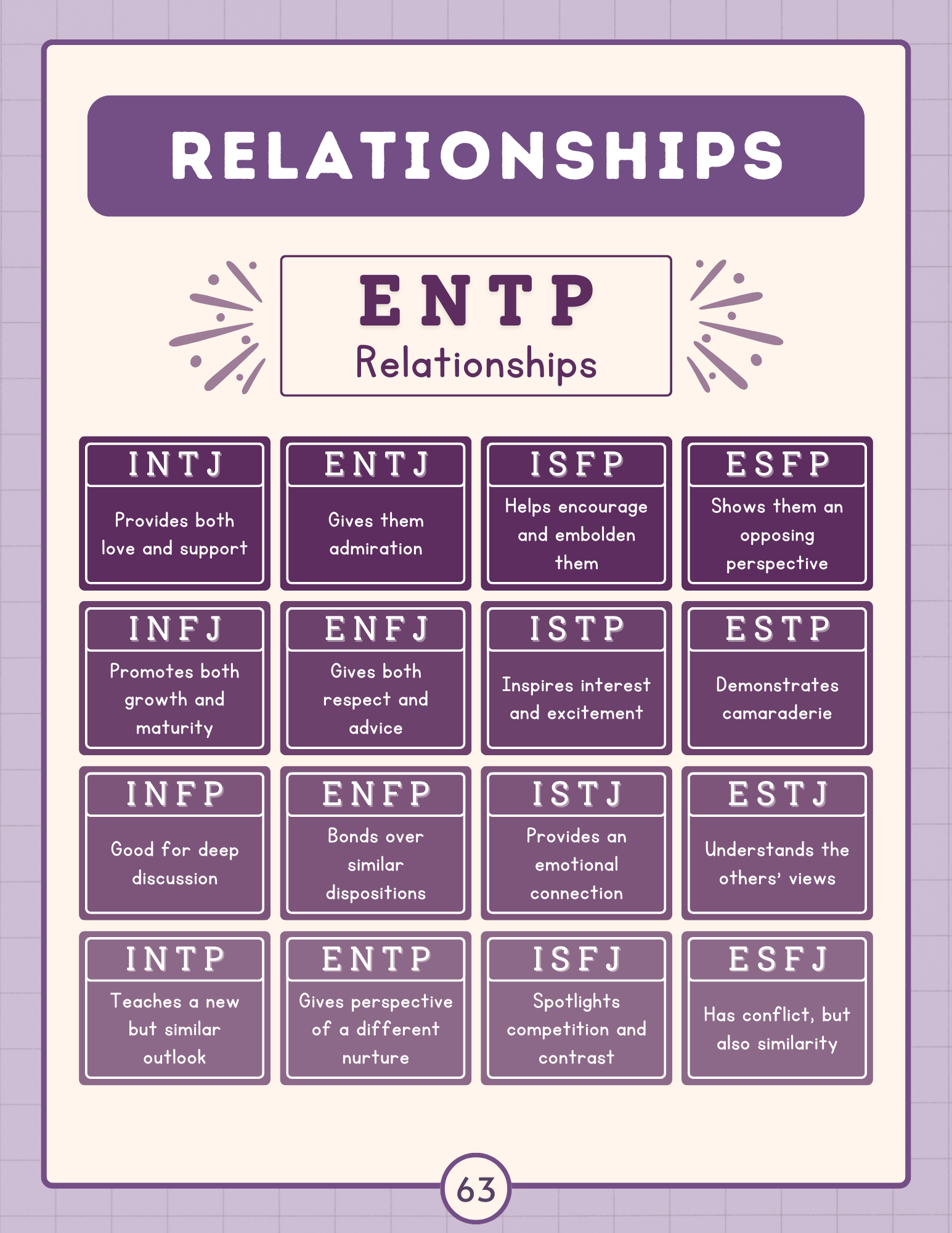
Not sure you are really an ENTP?
ENTP gets confused with ENFP and INTP all the time. If you want to be certain, a typing session will settle it.