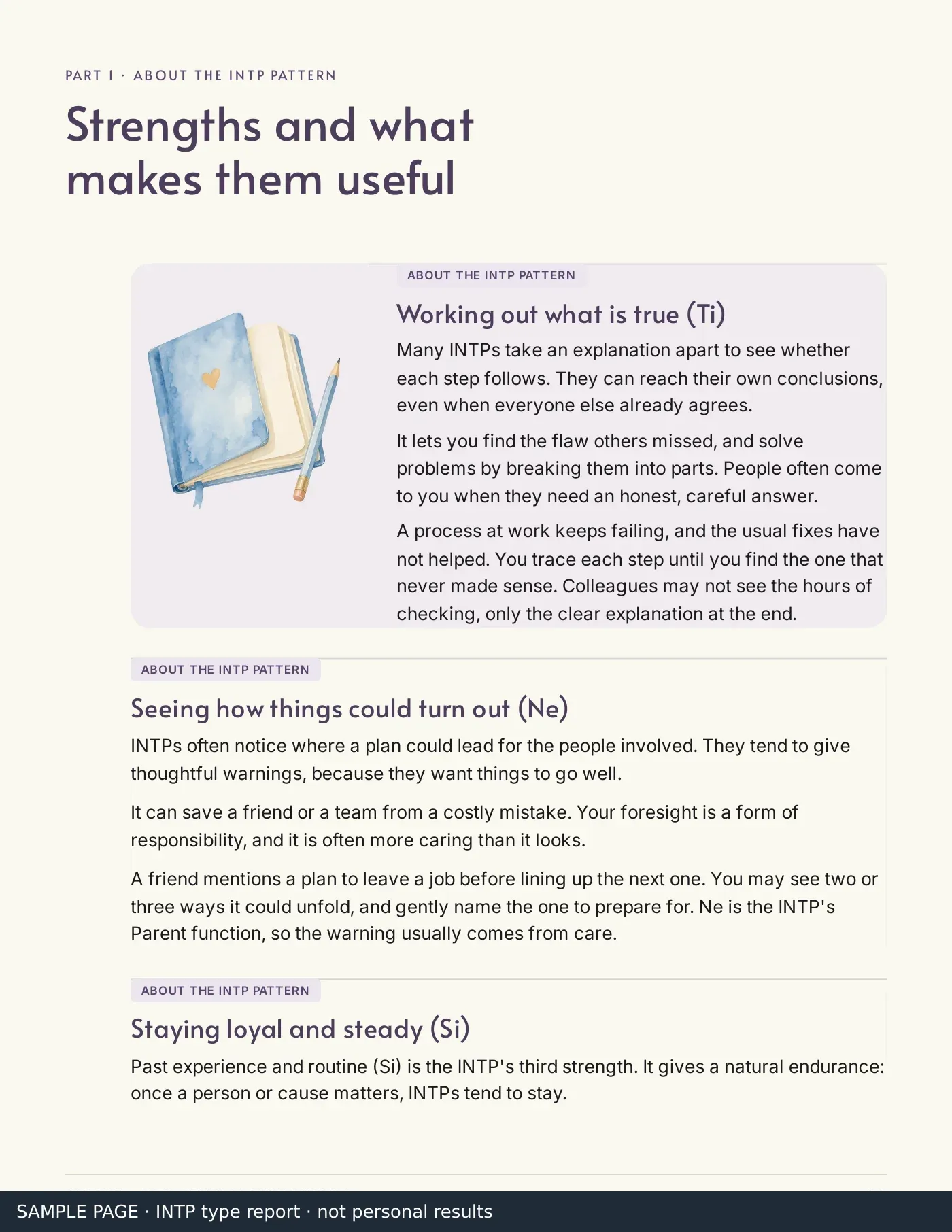
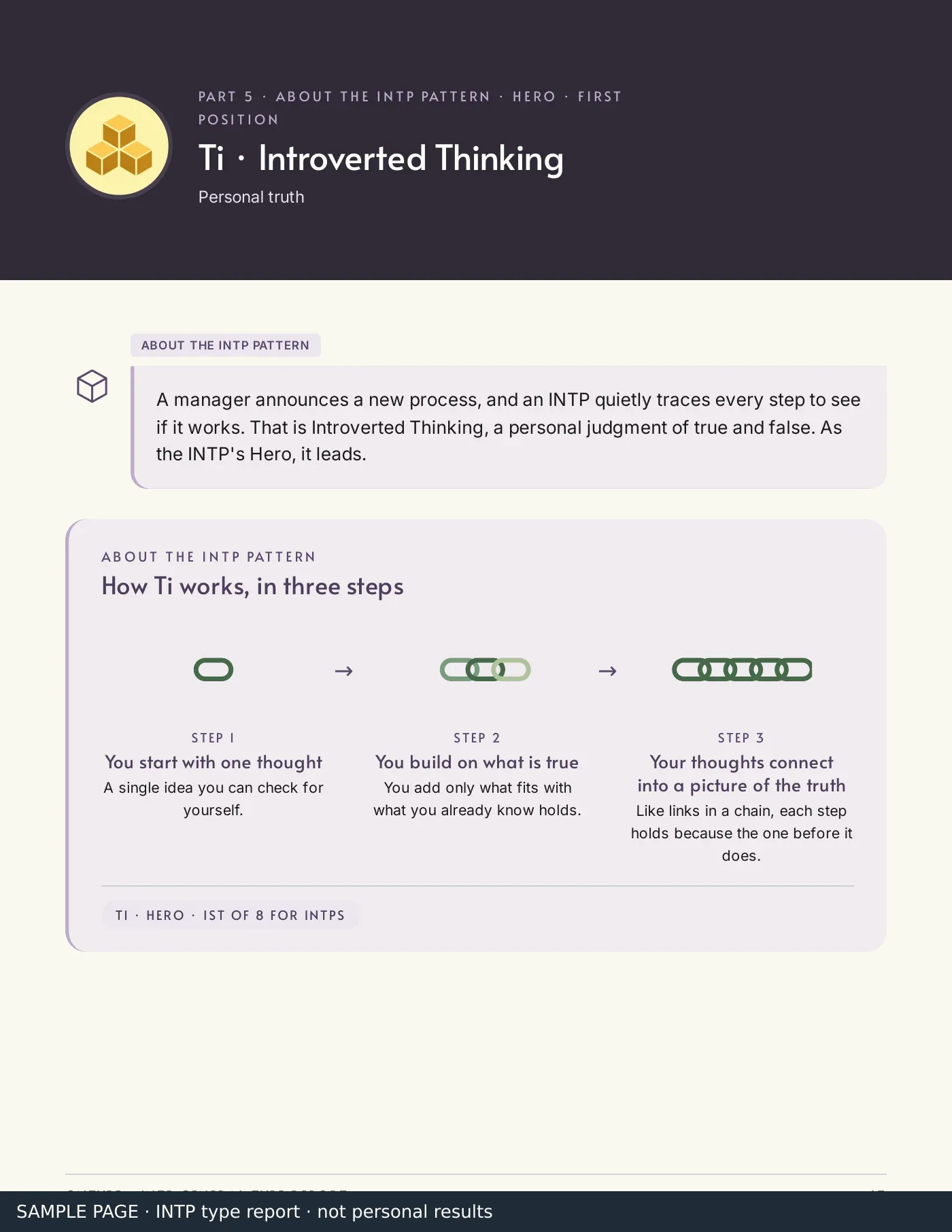
INTPs often need an idea to make sense on its own terms before they accept it, even when everyone else already agrees. Given something new, they tend to take it apart, test whether it holds together, and rebuild it in a way that is logically sound to them. They also tend to see how things could turn out, so they may point out what could go wrong in a plan before anyone asks.
Others may experience INTPs as quiet and precise, often adding the context that makes an outcome work. They usually want time to think things through, freedom to question assumptions, and problems that are genuinely interesting to solve.
What INTPs often bring
Working out what is true independently
Anticipating consequences for others
Staying loyal to people and causes
Free · In everyday life
How everyday life can look for INTPs
Examples from the INTP type description. These are general patterns, not a reading of anyone’s answers.
When a new question meets a settled answer
The situation Years ago, an INTP worked out why the old car kept stalling, and they were right. Working out what is true for yourself (Ti) leads for INTPs, and the click of a finished answer is earned.
What may be behind it Loyalty and past experience (Si) sit in the Child position, beside the Hero, and they attach to conclusions as well as people. When a friend suggests a different cause for a new problem, the old answer can feel like something to defend.
A thought to take with you A trusted conclusion can stay open to one more question without losing its value.
Closer look
Years ago, an INTP worked out why the old car kept stalling, and they were right. Working out what is true for yourself (Ti) leads for INTPs, and the click of a finished answer is earned.
Loyalty and past experience (Si) sit in the Child position, beside the Hero, and they attach to conclusions as well as people. When a friend suggests a different cause for a new problem, the old answer can feel like something to defend.
A trusted conclusion can stay open to one more question without losing its value. Either outcome helps, and a friend who feels fully heard is readier to hear the INTP's reasoning in return.
Why steady loyalty can go unseen
The situation An INTP fixes a friend's wobbly laptop every few weeks for a year and never mentions it. As the INTP's Child function, Si (Introverted Sensing) brings loyalty with real endurance.
What may be behind it From outside, the INTP can look calm and a little distant. Because the help arrives as action, not words, people may take it for granted.
A thought to take with you Long, quiet support is easy to miss.
Closer look
An INTP fixes a friend's wobbly laptop every few weeks for a year and never mentions it. As the INTP's Child function, Si brings loyalty with real endurance.
From outside, the INTP can look calm and a little distant. Because the help arrives as action, not words, people may take it for granted.
Long, quiet support is easy to miss. An occasional brief message, such as asking how the laptop is holding up, lets people see the steadiness behind it.
The way your type thinks and decides
Four parts of the INTP personality
There is more than one way to understand a situation. These four functions describe the different kinds of attention and judgment that tend to work together for INTPs. Each part has a different job. Here is what that can look like in an ordinary day.
Ti
Ne
Si
Fe
01The first instinct · TiMaking sense of thingsChecking ideas against your own reasoning until they feel consistent.
When a plan sounds convincing, you may still want to understand why it works. Asking one more question can help you make a decision that makes sense to you.
02A steady support · NeNoticing possibilitiesSeeing what might happen next and how different paths could unfold.
When someone shares an idea, you may quickly see several ways it could develop. Picturing those paths can help you anticipate consequences and the options other people might choose.
03A more playful side · SiLearning from experienceDrawing on remembered experience, familiar routines, and what has worked before.
When a new situation comes along, you may remember a similar experience and what helped you feel prepared. Familiar details can make it easier to decide what to do next.
04A side to explore · FeUnderstanding peoplePaying attention to how others feel and what helps people get along.
If someone seems left out of a conversation, you might invite them in or check how they are doing. Small gestures can help everyone feel considered.
This is a guide to the general INTP pattern, not a reading of your individual questionnaire answers.
Sample profile
What your function profile will look like
This is a sample: the textbook INTP shape, not anyone's answers. Take the free test and your own profile appears here.
Sample, not your answers
How to read it: Each column is one function. The four on the left are the main functions in stack order, starting with the Hero, Ti (Introverted Thinking), so the line steps down from left to right. The four on the right work in the background. Illustrative: the textbook INTP shape, not a measured result.
Textbook INTP shape
Ti Hero
Ne Parent
Si Child
Fe Aspirational
Te Nemesis
Ni Critic
Se Trickster
Fi Demon
Ti · Introverted Thinking
Hero: The function you reach for first, and with ease
Personal reasoning: whether something makes sense to you.
Take the free test to see where your own answers fall.
Ne · Extraverted Intuition
Parent: A supporting function that keeps your main approach balanced and responsible
Other people's wants, possibilities, consequences and the shared future.
Take the free test to see where your own answers fall.
Si · Introverted Sensing
Child: A more playful, and more vulnerable, part of your personality
Personal experience, memory, comfort, routine, duty and the body.
Take the free test to see where your own answers fall.
Fe · Extraverted Feeling
Aspirational: A less natural ability that can become an important area of growth
Other people's feelings, shared ethics, care and fairness.
Take the free test to see where your own answers fall.
Te · Extraverted Thinking
Nemesis: Where worry and second-guessing tend to show up
Looking for what is true in outside evidence: sources, verifiable facts, rules and reputation.
Take the free test to see where your own answers fall.
Ni · Introverted Intuition
Critic: Where harsh judgment, often of yourself, can appear
Personal wants, intentions, goals and future direction.
Take the free test to see where your own answers fall.
Se · Extraverted Sensing
Trickster: An area that gets little automatic attention, so blind spots are likely
Present physical reality, shared experience and other people's comfort.
Take the free test to see where your own answers fall.
Fi · Introverted Feeling
Demon: Your least conscious side, linked to strong reactions under serious stress
Personal values, self-worth and what you appreciate.
Take the free test to see where your own answers fall.
Illustrative values. The graph above shows the textbook INTP shape. These numbers are examples, not measured results.
0 to 100 describes how consistently your answers leaned toward a function. It is not a measure of ability, and it is not compared with anyone else.