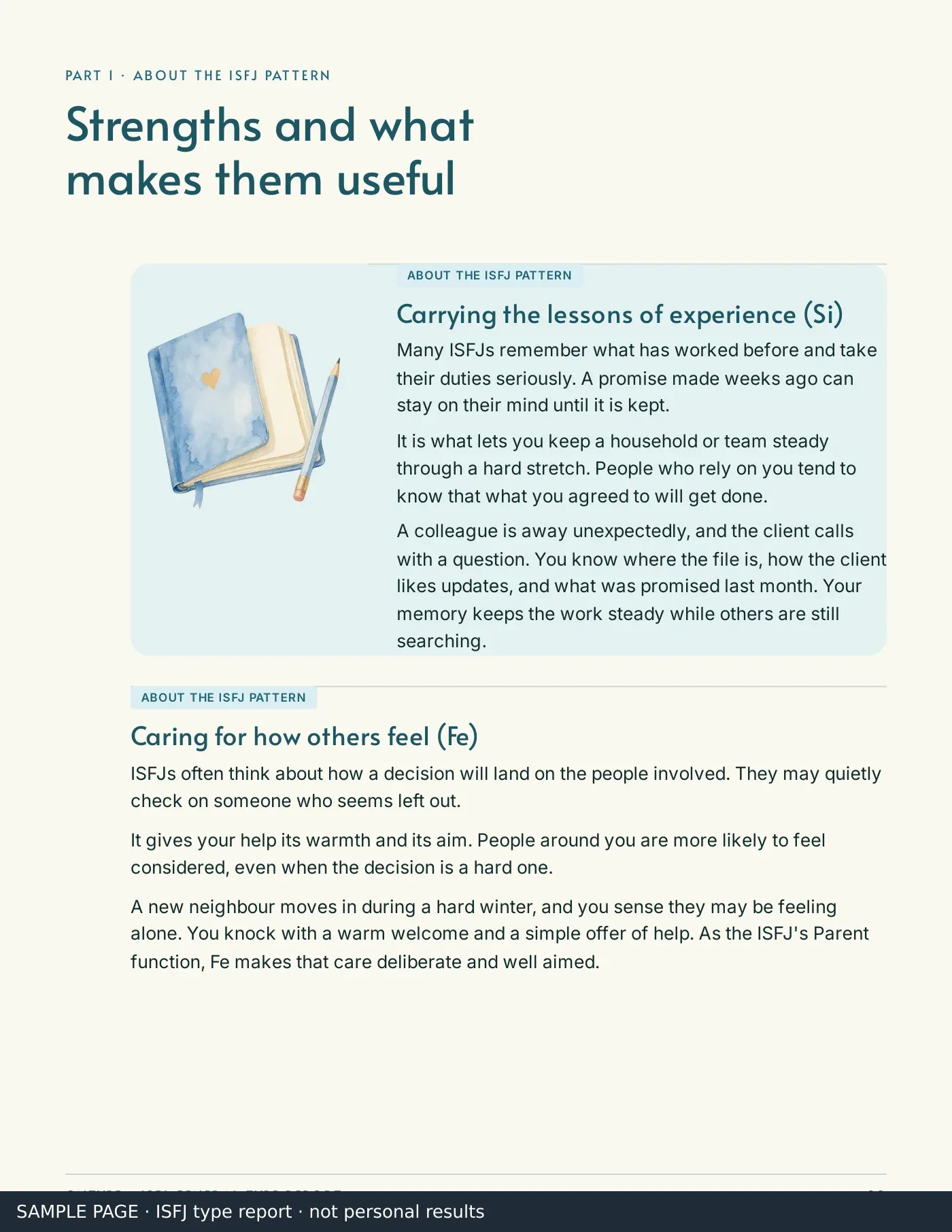
ISFJs often rely on what has worked before, and they take the commitments they make seriously. Routines and past experience help them get things done well, and an unfinished promise or responsibility can sit uneasily with them. They also pay close attention to how decisions land on other people, and may quietly check on someone who seems left out.
Others may know ISFJs as steady and dependable, often supporting a group in practical ways that nobody announces. They tend to want stability, appreciation for the care they put in, and people around them who keep their word.
What ISFJs often bring
Following through on duties and routines
Responsible attention to others' feelings
Reasoning independently about what is true
Free · In everyday life
How everyday life can look for ISFJs
Examples from the ISFJ type description. These are general patterns, not a reading of anyone’s answers.
When a family tradition meets a new suggestion
The situation For years, an ISFJ has hosted the holiday dinner the same way, and it works. Past experience and routine (Si) leads for ISFJs, so changing a proven method can feel like setting that experience aside.
What may be behind it Exploring other possibilities (Ne) sits in the Aspirational position. When a sibling suggests a potluck instead, curiosity and unease may arrive together, especially if the ISFJ is unsure what the sibling really wants.
A thought to take with you A trusted tradition and a new idea can both deserve a fair hearing.
Closer look
For years, an ISFJ has hosted the holiday dinner the same way, and it works. Past experience and routine (Si) leads for ISFJs, so changing a proven method can feel like setting that experience aside.
Exploring other possibilities (Ne) sits in the Aspirational position. When a sibling suggests a potluck instead, curiosity and unease may arrive together, especially if the ISFJ is unsure what the sibling really wants.
A trusted tradition and a new idea can both deserve a fair hearing. Keeping the parts that matter while trying one change feels safer than all or nothing, and the tradition grows to include what was learned.
Why personal wishes can go unseen
The situation When friends pick a restaurant, an ISFJ often says anywhere is fine. Care for how others feel (Fe) is the ISFJ's Parent function, so attention stays on what everyone else would enjoy.
What may be behind it Others see someone happy to go along and assume nothing is missing. They may not realize a preference has been waiting for a long time.
A thought to take with you Wishes are easier for others to respect once they are spoken.
Closer look
When friends pick a restaurant, an ISFJ often says anywhere is fine. Care for how others feel (Fe) is the ISFJ's Parent function, so attention stays on what everyone else would enjoy.
Others see someone happy to go along and assume nothing is missing. They may not realize a preference has been waiting for a long time.
Wishes are easier for others to respect once they are spoken. Naming one small preference now and then lets friends know you better, and keeps kindness flowing both ways.
The way your type thinks and decides
Four parts of the ISFJ personality
There is more than one way to understand a situation. These four functions describe the different kinds of attention and judgment that tend to work together for ISFJs. Each part has a different job. Here is what that can look like in an ordinary day.
Si
Fe
Ti
Ne
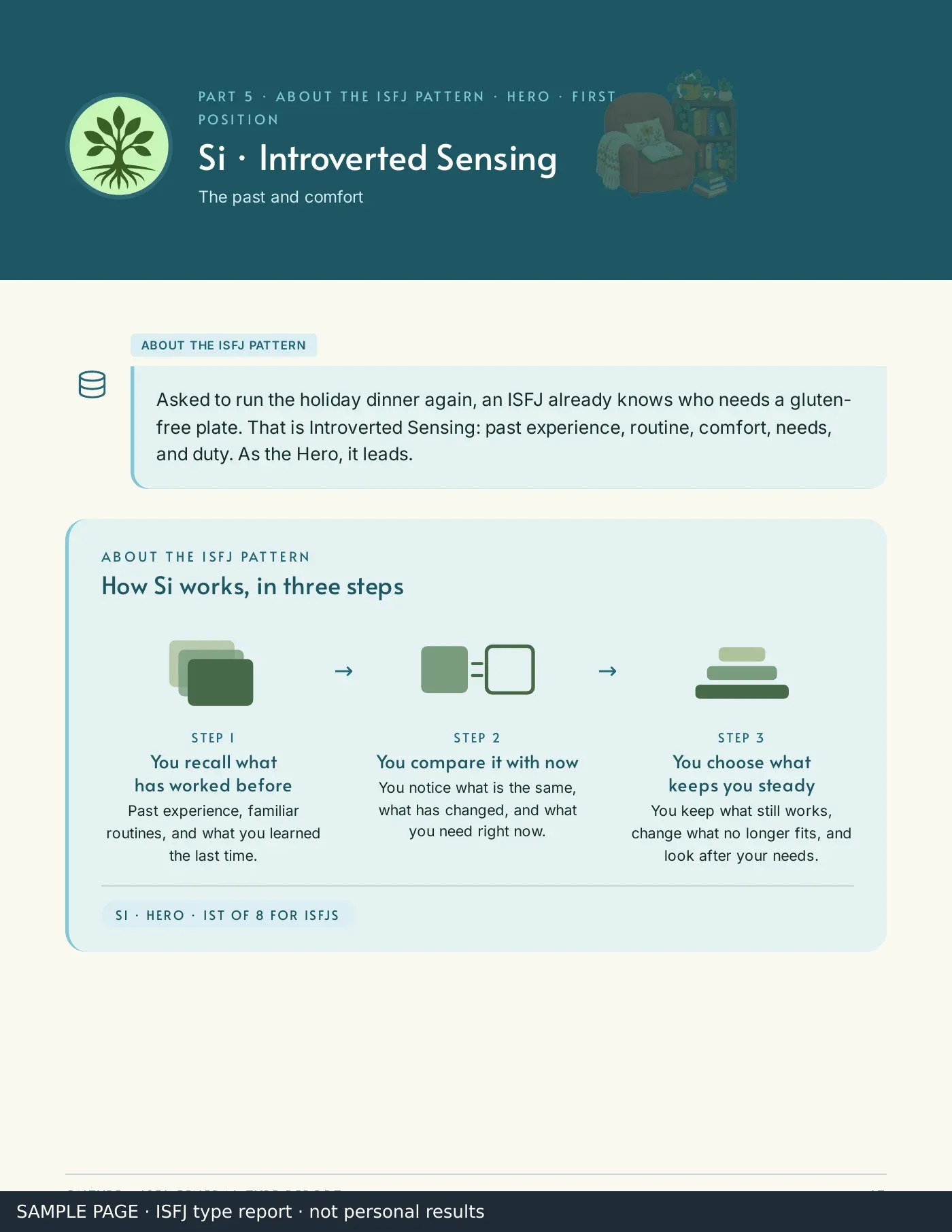
01The first instinct · SiLearning from experienceDrawing on remembered experience, familiar routines, and what has worked before.
When a new situation comes along, you may remember a similar experience and what helped you feel prepared. Familiar details can make it easier to decide what to do next.
02A steady support · FeUnderstanding peoplePaying attention to how others feel and what helps people get along.
If someone seems left out of a conversation, you might invite them in or check how they are doing. Small gestures can help everyone feel considered.
03A more playful side · TiMaking sense of thingsChecking ideas against your own reasoning until they feel consistent.
When a plan sounds convincing, you may still want to understand why it works. Asking one more question can help you make a decision that makes sense to you.
04A side to explore · NeNoticing possibilitiesSeeing what might happen next and how different paths could unfold.
When someone shares an idea, you may quickly see several ways it could develop. Picturing those paths can help you anticipate consequences and the options other people might choose.
This is a guide to the general ISFJ pattern, not a reading of your individual questionnaire answers.
Sample profile
What your function profile will look like
This is a sample: the textbook ISFJ shape, not anyone's answers. Take the free test and your own profile appears here.
Sample, not your answers
How to read it: Each column is one function. The four on the left are the main functions in stack order, starting with the Hero, Si (Introverted Sensing), so the line steps down from left to right. The four on the right work in the background. Illustrative: the textbook ISFJ shape, not a measured result.
Textbook ISFJ shape
Si Hero
Fe Parent
Ti Child
Ne Aspirational
Se Nemesis
Fi Critic
Te Trickster
Ni Demon
Si · Introverted Sensing
Hero: The function you reach for first, and with ease
Personal experience, memory, comfort, routine, duty and the body.
Take the free test to see where your own answers fall.
Fe · Extraverted Feeling
Parent: A supporting function that keeps your main approach balanced and responsible
Other people's feelings, shared ethics, care and fairness.
Take the free test to see where your own answers fall.
Ti · Introverted Thinking
Child: A more playful, and more vulnerable, part of your personality
Personal reasoning: whether something makes sense to you.
Take the free test to see where your own answers fall.
Ne · Extraverted Intuition
Aspirational: A less natural ability that can become an important area of growth
Other people's wants, possibilities, consequences and the shared future.
Take the free test to see where your own answers fall.
Se · Extraverted Sensing
Nemesis: Where worry and second-guessing tend to show up
Present physical reality, shared experience and other people's comfort.
Take the free test to see where your own answers fall.
Fi · Introverted Feeling
Critic: Where harsh judgment, often of yourself, can appear
Personal values, self-worth and what you appreciate.
Take the free test to see where your own answers fall.
Te · Extraverted Thinking
Trickster: An area that gets little automatic attention, so blind spots are likely
Looking for what is true in outside evidence: sources, verifiable facts, rules and reputation.
Take the free test to see where your own answers fall.
Ni · Introverted Intuition
Demon: Your least conscious side, linked to strong reactions under serious stress
Personal wants, intentions, goals and future direction.
Take the free test to see where your own answers fall.
Illustrative values. The graph above shows the textbook ISFJ shape. These numbers are examples, not measured results.
0 to 100 describes how consistently your answers leaned toward a function. It is not a measure of ability, and it is not compared with anyone else.