ISTPs often need to understand how something actually works before they accept it. Given a new idea or tool, they tend to take it apart, test it and see whether it holds up, even if others already agree. They also pay attention to practical details: when they do something for someone, they want it to work properly in real life.
Others may experience ISTPs as calm and direct, often the person who quietly fixes the problem. They usually want independence, hands-on problems to solve, and freedom from rules that serve no purpose.
What ISTPs often bring
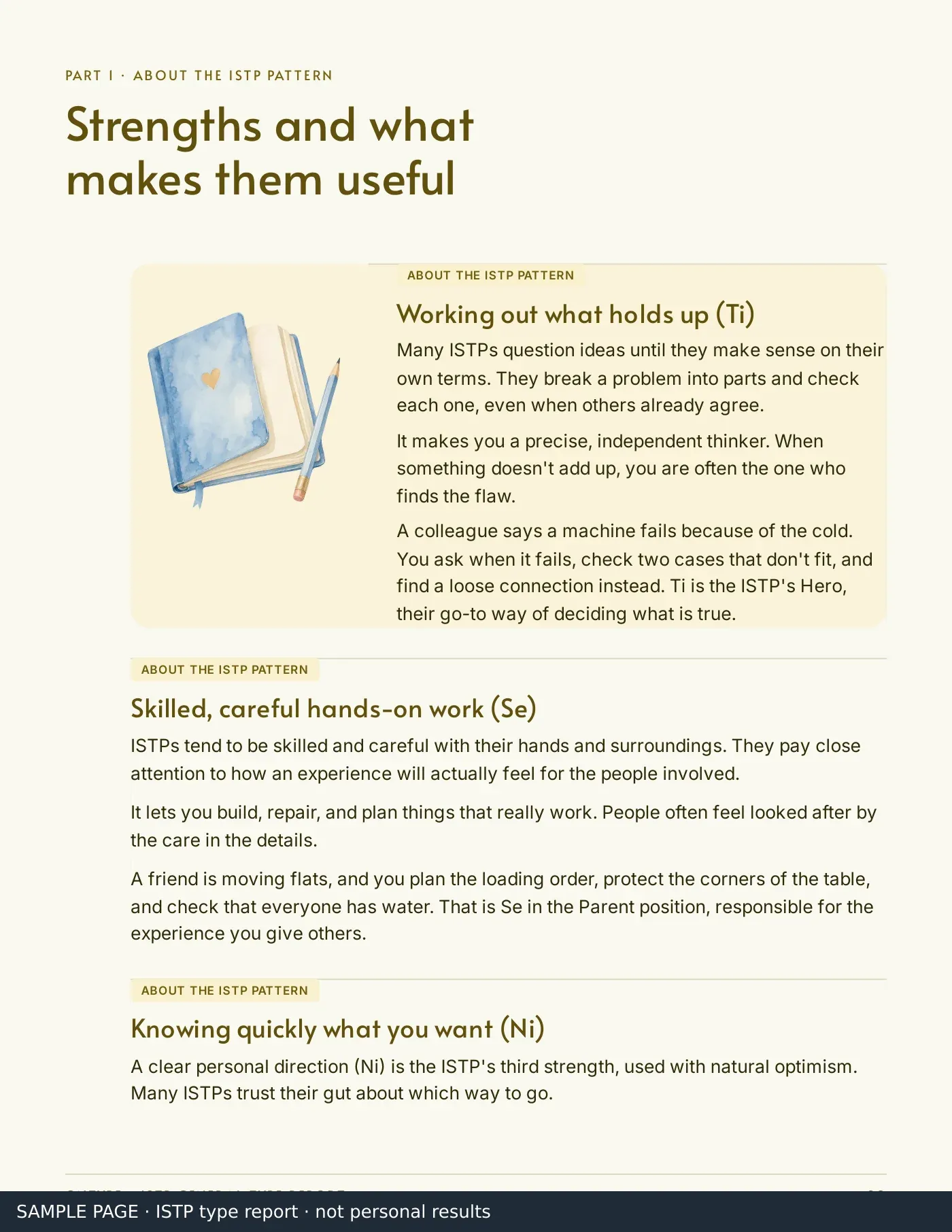
Working out what is true independently
Skilled, careful hands-on work
Knowing quickly what they want
Free · In everyday life
How everyday life can look for ISTPs
Examples from the ISTP type description. These are general patterns, not a reading of anyone’s answers.
When your reasoning meets a friend's explanation
The situation An ISTP has worked out exactly why the bike's gears keep slipping. Working out what is true for yourself (Ti) leads for ISTPs, so a conclusion that clicks can feel complete, and it often points to a sound answer.
What may be behind it Looking for what is true in outside evidence (Te) is the ISTP's Nemesis, a place of worry. When a friend quotes a video with a different fix, it may feel like a challenge to the ISTP's competence, even when the friend simply knows something different.
A thought to take with you A sound conclusion is easier to trust once it has met at least one other view.
Closer look
An ISTP has worked out exactly why the bike's gears keep slipping. Working out what is true for yourself (Ti) leads for ISTPs, so a conclusion that clicks can feel complete, and it often points to a sound answer.
Looking for what is true in outside evidence (Te) is the ISTP's Nemesis, a place of worry. When a friend quotes a video with a different fix, it may feel like a challenge to the ISTP's competence, even when the friend simply knows something different.
A sound conclusion is easier to trust once it has met at least one other view. Sometimes the other view fills a gap; sometimes the ISTP's answer holds up better for having been tested.
Why quiet, practical care can go unseen
The situation Before a friend's long drive, an ISTP checks the tire pressure without mentioning it. Se (Extraverted Sensing) in the Parent position pays close attention to the experience their actions create for others.
What may be behind it The friend may never know. Help this quiet can read as habit, when it was really a choice made for them.
A thought to take with you Kindness that lives in what you do may need a few words to be recognized.
Closer look
Before a friend's long drive, an ISTP checks the tire pressure without mentioning it. Se in the Parent position pays close attention to the experience their actions create for others.
The friend may never know. Help this quiet can read as habit, when it was really a choice made for them.
Kindness that lives in what you do may need a few words to be recognized. Naming the reason now and then lets people see the thought behind it.
The way your type thinks and decides
Four parts of the ISTP personality
There is more than one way to understand a situation. These four functions describe the different kinds of attention and judgment that tend to work together for ISTPs. Each part has a different job. Here is what that can look like in an ordinary day.
Ti
Se
Ni
Fe
01The first instinct · TiMaking sense of thingsChecking ideas against your own reasoning until they feel consistent.
When a plan sounds convincing, you may still want to understand why it works. Asking one more question can help you make a decision that makes sense to you.
02A steady support · SeTaking in the momentNoticing what is happening around you and responding to real experience.
You might brighten someone’s day through something tangible: a shared outing, a thoughtful gesture, or noticing what would make the moment better.
03A more playful side · NiFinding a directionChoosing a direction for your own future and focusing on it.
Before committing to a plan, you might ask whether it fits the future you want. Once the direction is clear, you can stay focused and determined, even when progress is slow.
04A side to explore · FeUnderstanding peoplePaying attention to how others feel and what helps people get along.
If someone seems left out of a conversation, you might invite them in or check how they are doing. Small gestures can help everyone feel considered.
This is a guide to the general ISTP pattern, not a reading of your individual questionnaire answers.
Sample profile
What your function profile will look like
This is a sample: the textbook ISTP shape, not anyone's answers. Take the free test and your own profile appears here.
Sample, not your answers
How to read it: Each column is one function. The four on the left are the main functions in stack order, starting with the Hero, Ti (Introverted Thinking), so the line steps down from left to right. The four on the right work in the background. Illustrative: the textbook ISTP shape, not a measured result.
Textbook ISTP shape
Ti Hero
Se Parent
Ni Child
Fe Aspirational
Te Nemesis
Si Critic
Ne Trickster
Fi Demon
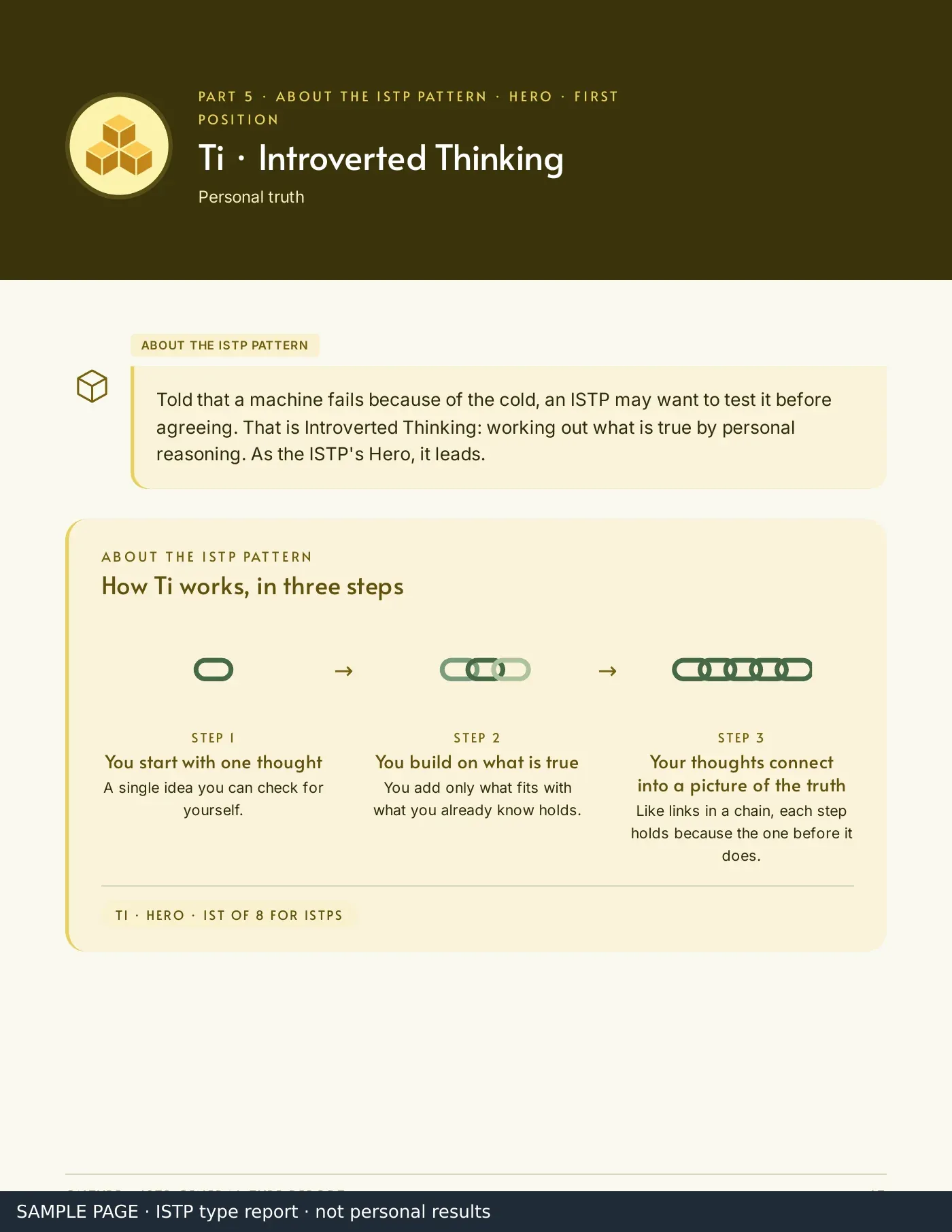
Ti · Introverted Thinking
Hero: The function you reach for first, and with ease
Personal reasoning: whether something makes sense to you.
Take the free test to see where your own answers fall.
Se · Extraverted Sensing
Parent: A supporting function that keeps your main approach balanced and responsible
Present physical reality, shared experience and other people's comfort.
Take the free test to see where your own answers fall.
Ni · Introverted Intuition
Child: A more playful, and more vulnerable, part of your personality
Personal wants, intentions, goals and future direction.
Take the free test to see where your own answers fall.
Fe · Extraverted Feeling
Aspirational: A less natural ability that can become an important area of growth
Other people's feelings, shared ethics, care and fairness.
Take the free test to see where your own answers fall.
Te · Extraverted Thinking
Nemesis: Where worry and second-guessing tend to show up
Looking for what is true in outside evidence: sources, verifiable facts, rules and reputation.
Take the free test to see where your own answers fall.
Si · Introverted Sensing
Critic: Where harsh judgment, often of yourself, can appear
Personal experience, memory, comfort, routine, duty and the body.
Take the free test to see where your own answers fall.
Ne · Extraverted Intuition
Trickster: An area that gets little automatic attention, so blind spots are likely
Other people's wants, possibilities, consequences and the shared future.
Take the free test to see where your own answers fall.
Fi · Introverted Feeling
Demon: Your least conscious side, linked to strong reactions under serious stress
Personal values, self-worth and what you appreciate.
Take the free test to see where your own answers fall.
Illustrative values. The graph above shows the textbook ISTP shape. These numbers are examples, not measured results.
0 to 100 describes how consistently your answers leaned toward a function. It is not a measure of ability, and it is not compared with anyone else.